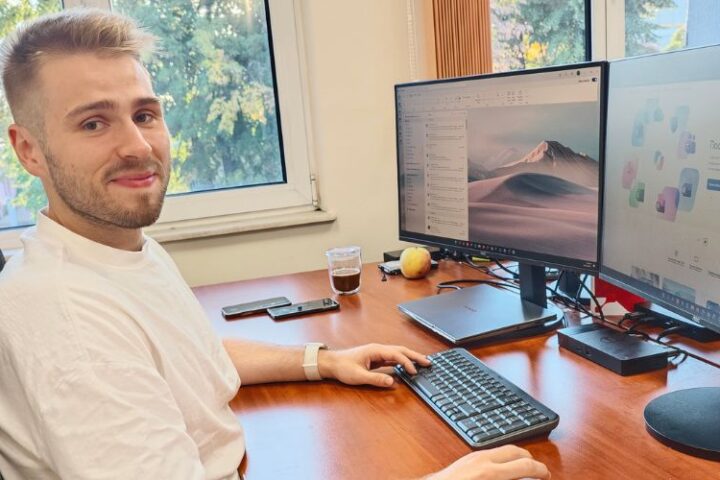
Why Stabil: Plamen Mladenov talks about the people, projects and work at Stabilengineering-Alfa
Four years ago, Plamen Mladenov’s career path brought him to Stabilengineering-Alfa. Since then, he has contributed to numerous successful projects, helped build hundreds of metres of industrial installations and gained experience leading the largest project the company has completed to date.
For Plamen, however, true success is not measured by numbers alone. It comes from having a well-prepared team, working safely, delivering every detail with precision and seeing something you helped create come to life and bring real value to the client.
In this new interview from our “Why Stabil” series, we speak with Plamen Mladenov about his first steps at Stabilengineering-Alfa, the specifics of working with stainless steel, the challenges of delivering large industrial projects and the lessons people can both share with and learn from their team.
Hello, Plamen! You have been part of Stabilengineering-Alfa for four years now. How did your journey with the company begin?
Hello! Honestly, it happened by chance. I already had a job and held a good position as a product manager at a DIY store. However, disrespectful treatment from the general manager made me look for a new opportunity.
At the same time, Stabilengineering-Alfa was looking for someone who could learn the specifics of installation work, gain knowledge and experience from Eng. Georgi Dimitrov and eventually take over his position completely. That is how my path crossed with the company’s.
How would you describe your team’s work to someone who is unfamiliar with the processing industry?
The work is interesting, engaging and rewarding.
- It is interesting because it is varied and never repetitive.
- It is engaging because once we begin building an installation or installing equipment, you naturally want to see the project through to a successful completion. You want to see the finished system working, something created by you and the installation team.
- It is rewarding because, once the project is complete, you can see how the work you and your team have done benefits both the client and the company you work for.
A large part of your work involves stainless-steel vessels and equipment. What matters most when manufacturing this type of equipment?
Stainless steel is a very specific material, and I knew very little about it before joining Stabilengineering-Alfa. It is much tougher than carbon steel and requires specialised machinery and abrasives during processing.
It can also be contaminated very easily by particles from carbon steel, which may cause it to oxidise and rust. That is why it must be handled carefully and certain rules must be followed when manufacturing and processing stainless-steel products.
Which part of your work requires the greatest attention and precision?
In my role, there are three main areas that require particular attention.
- The first is preparing installation quotations that are as accurate, detailed and precise as possible. They need to account for the potential challenges and unexpected issues that may arise on site. The goal is to achieve the best possible return while avoiding hidden problems that could reduce the project’s profitability.
- The second is making sure the team has everything it needs before installation begins, including materials, tools and lifting and transport equipment. This helps us avoid wasting time and fuel during the installation itself, which would also affect profitability.
- Last but certainly not least is following all safety measures and protecting the health and lives of the installation technicians working on site. Many of our projects take place in factories, workshops, dairies, wineries and breweries that are either under construction or already operating. Our teams often work at heights of two or three metres and above, use lifting and transport equipment and work alongside other contractors. If proper care is not taken, these conditions can easily lead to accidents.
What are the most common challenges when manufacturing stainless-steel vessels and equipment?
As I mentioned, stainless steel is a specialised material and is slightly more difficult to work with than carbon steel. Like most metals, it can distort when heated during welding. This can make it harder to assemble the individual parts of a product or installation.
Fortunately, we have experienced welders and fitters who know how to minimise these effects during processing and achieve excellent results.
Another challenge is keeping the product or installation clean and free from iron contamination. After all, there is little point in using a corrosion-resistant material if it begins to rust because it was handled carelessly during production.
Which project from the past four years makes you the proudest?
There are many projects I am pleased with, but the one I am proudest of is also the largest: the construction of pipelines and the connection of vessels, pumps and valves at Index 11 AD’s new production facility.
It is the first plant in Europe and the third in the world to produce natural beta-carotene from yeast using innovative Bulgarian technology.
The project was completed with the involvement of Insa Oil EOOD and the University of Food Technologies in Plovdiv. Our contribution to this major undertaking included the installation of 3,878 metres of piping, 5,240 fittings and components, including flanges, valves, filters, air vents, elbows, tees and reducers,as well as 1,509 support structures, brackets and pipe racks.
The project presented several challenges. It ran from September 2024 to April 2026 and involved working outdoors in temperatures ranging from –10°C to +40°C, in heat, snow, rain and wind. We also worked at heights of up to 15 metres and had to meet the high standards set by the client, Index 11 AD.
For me, the true satisfaction and pride come after the project has been completed, but only when three important conditions have been met:
- Every installation technician who worked on the site has returned home safe and well, without accidents or injuries.
- Our work has been accepted by the client and construction supervision team without any remarks. This follows mandatory radiographic and visual inspection of the welds, as well as strength and leak testing of the process pipelines. The client, whom we worked with for the first time, is satisfied, which creates opportunities for future cooperation.
- The client has paid all outstanding amounts and, after reviewing the reports and analyses, we have calculated the net profit generated by the completed project.


What made this project different or particularly interesting for you and the team?
For me personally, the project was a major challenge, primarily because of its scale. It was the largest project I had ever worked on and managed.
My colleague and mentor, Eng. Georgi Dimitrov, and I began managing the installation work in September 2024. Four months later, he decided that I was ready to complete the project independently and took his well-earned retirement.
The work was interesting and exciting. It involved communicating with refinery designers, colleagues from other companies working on the site, and suppliers of the materials and equipment required for the project.
As for the team, this was not the work of a single installation crew. The entire company was involved. There was hardly an employee who did not contribute to the project. The design engineers from the technical department, led by Eng. Stefan Mirev, were also actively involved and supported its completion.
I believe the project was interesting for everyone because of its scale and because we were helping to create a facility that is the first of its kind in Europe and only the third in the world.
How does it feel to see equipment that you helped create from the very beginning fully installed and operating in a production facility?
For me, the feeling is one of satisfaction. I like seeing the results of our work in operation, and that is exactly what happened with this project.
As a team leader, what matters most to you when working with people?
Respect, understanding, openness, communication, fairness and integrity. Most importantly, all of these values must go both ways.
How do you pass your experience and knowledge on to younger colleagues?
During my more than 30 years of experience leading teams, I have learned, first, how to quickly absorb other people’s knowledge and experience and, second, how to pass them on to those who are willing to learn.
Over the years, I have trained military personnel, chefs and kitchen staff, warehouse employees, sales assistants, sales representatives, automotive technicians and production workers. However, the person being trained must always have a genuine desire to learn.
My approach is to understand every detail of the work and become sufficiently competent in what I am studying, if not in practice, then at least in theory. After all, I do not need to become an expert welder in order to train and supervise welders.
The presentation and public-speaking skills I have developed over the years help me share the knowledge and experience I have gained. I see young colleagues as a blank page, ready for new knowledge. When you have the right experience, knowledge and practical understanding, it is not difficult to capture their interest.
What have you learned from your team over the past four years?
I have learned a great deal almost everything I know about installation work and stainless steel.
While Eng. Georgi Dimitrov mainly taught me the theory, the installation teams showed me the practical side of our work. I am good at learning by watching experienced professionals, and whenever I have had the opportunity to work alongside a more experienced colleague, I have made the most of it.
What do clients expect today that was not as important in the past?
Automation. It has become one of the most important requirements for clients today, mainly because of the shortage of production workers.
High quality is another major requirement. Bulgarian manufacturers now have a strong presence in international markets. As their supplier, you are subject to strict audits covering production quality and hygiene. This leads to higher expectations for the quality of the vessels we manufacture and, above all, the installations we build.
What role do automation and new technologies play in this industry?
As I mentioned, automation has become a major priority because of the labour shortage. More and more enquiries now include requirements for automating the processes carried out in the vessels and installations we build.
New technologies help every business improve its efficiency, quality and productivity. It is therefore important for us to take advantage of the opportunities they provide.
With this in mind, Stabilengineering-Alfa is currently exploring the possibility of importing, supplying and installing press-fit stainless-steel pipes and fittings.
Press fitting is a cleaner, faster and more modern method of building pipework and industrial installations. It is only beginning to gain ground in Bulgaria, but there is already demand from both clients and importers of press fittings, as there are still not enough installation companies with experience in this technology.
This type of connection also creates opportunities for us to build installations in production environments where spark-producing welding or other hot work is not permitted, including facilities with a risk of fire or explosion.
Which three words best describe your work at Stabilengineering-Alfa?
Interesting, engaging and rewarding.